Intelligence, authority & recovery
Architecture in developmentAEVION
Persistent intelligence architecture
The modular software architecture carrying user-owned context across replaceable engines and compatible hardware.
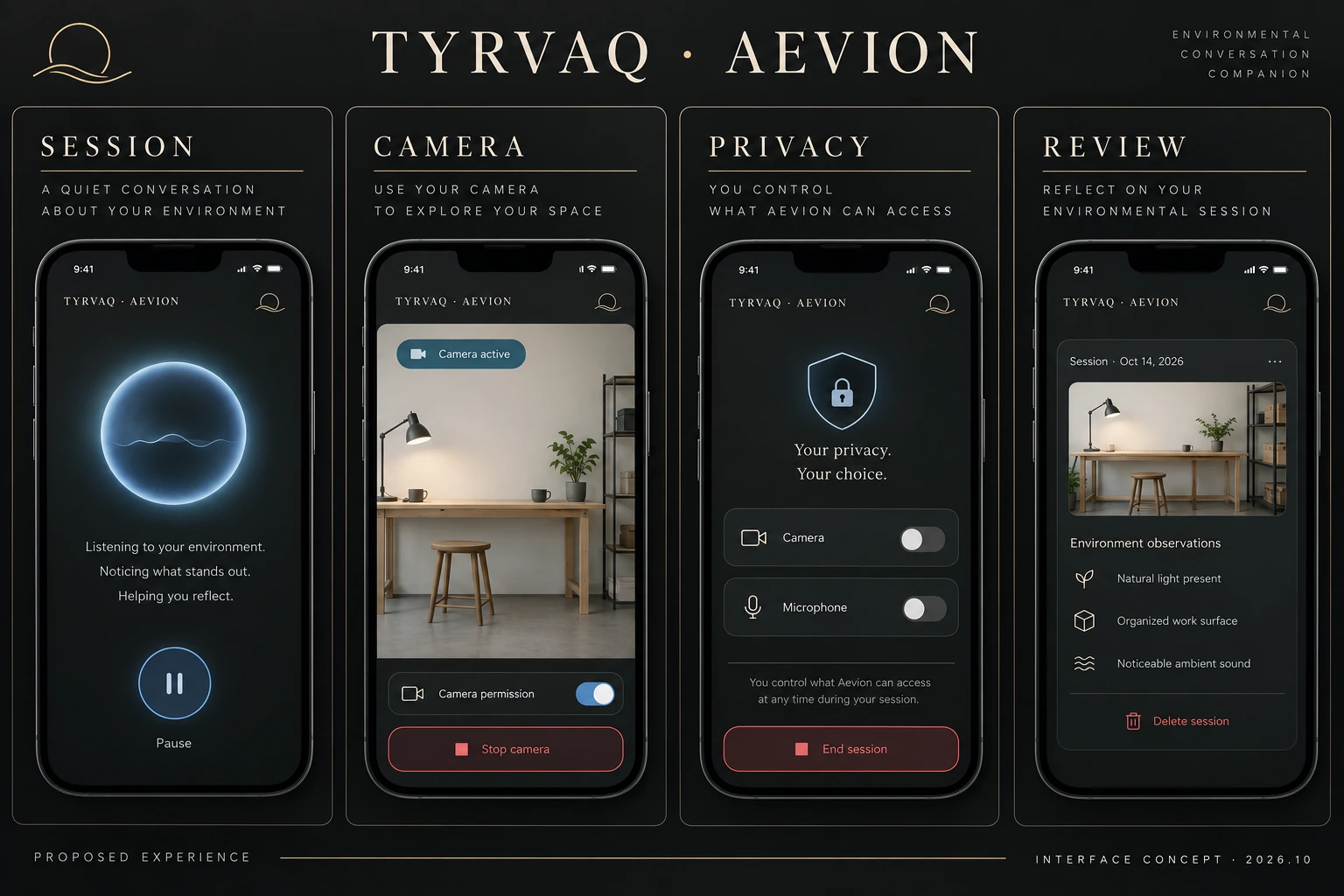
FIELD DOSSIER / TQ-18
Intelligence / persistent identity
- Physical mass
- Not applicable
- Physical size
- Host dependent
- Deployment
- CORE / web runtime
AEVION is software and architecture; it has no independent physical enclosure.
Model memory, compute and energy budgets belong to the selected host.
CURRENT STUDIES & ORIGINAL REFERENCES
The system, made visible.
Continuity before a particular model
The Continuity Kernel separates identity, continuity state and policy state from an engine adapter. A model can be replaced without assigning it ownership of the user's identity or the platform's authority.
Different layers answer different questions
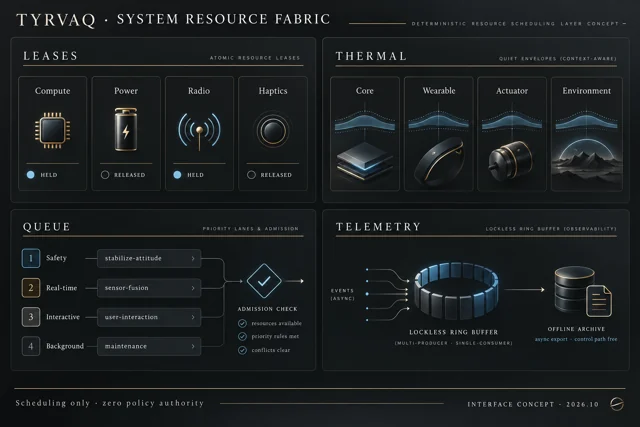
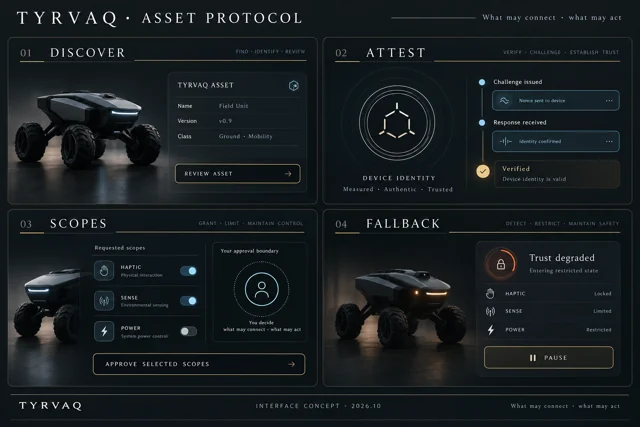
The Kernel establishes who is operating. GATE provides the assistant interface. SPARTA determines what may proceed. The Resource Fabric checks where and how it fits available resources. The ASSET Protocol describes the connected extension and its capabilities.
Evidence instead of self-report
A reasoning engine's claim that an action succeeded is insufficient. Proof-of-action and success attestation must come from independently verifiable results. Permission, execution and outcome remain separate records.
Connected roles
View architecture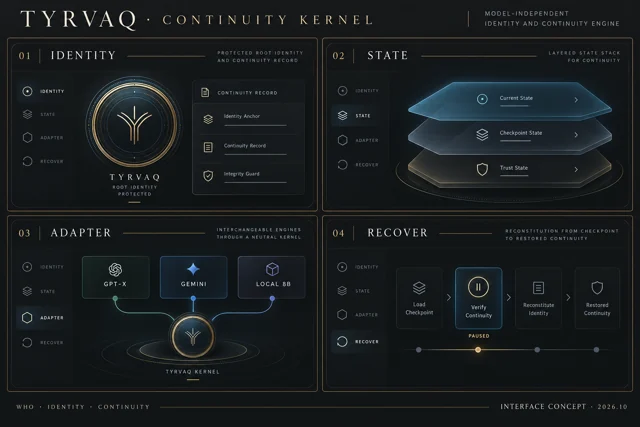 SYSTEM CONCEPT
CONTINUITY KERNEL
The identity, continuity and policy-state root beneath replaceable engine adapters.
 SYSTEM CONCEPT
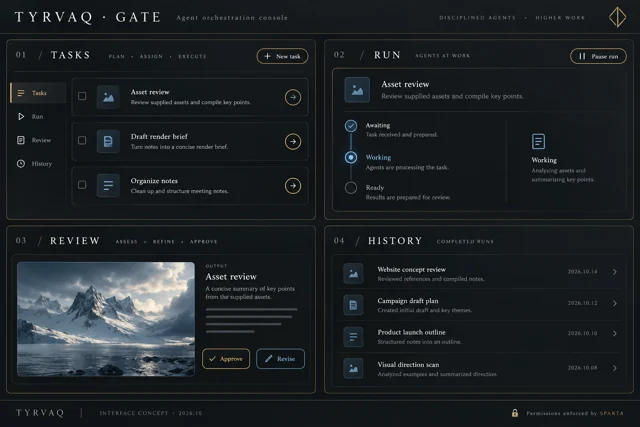
GATE
The user-facing assistant and reasoning interface, constrained by independent platform authority.
 SYSTEM CONCEPT
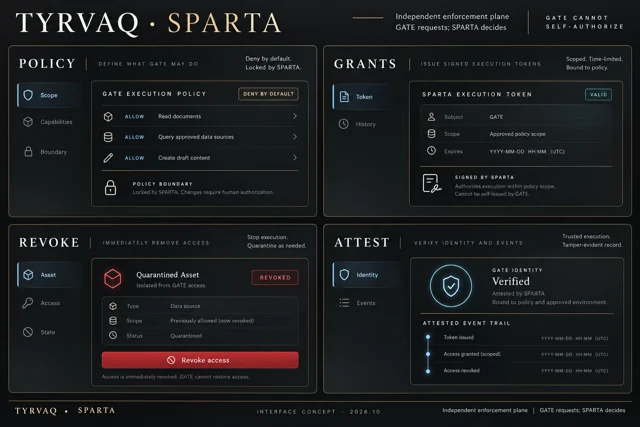
SPARTA
A model-independent authority compiler and external enforcement plane for finite, revocable execution.
 SYSTEM CONCEPT
SYSTEM RESOURCE FABRIC
A scheduler that checks authorized actions against timing, energy, storage and distinct thermal envelopes.
 SYSTEM CONCEPT
ASSET PROTOCOL
The zero-trust discovery, attestation and compatibility contract for a TYRVAQ extension.